Tuesday, July 1, 2025

Snow Leopard Cross Stitch

 Project Dates: 12/25/2002 - 3/30/2025


This is my second cross stitch project. I had just finished an American Indian themed cross stitch. Dave bought me this as a holiday present, circa 2002. It was in the last few years of living in Elgin.


It was part of a morning coffee routine with my husband. We would sit and enjoy each other’s company, chat about our dreams, and spend about a half hour. Then my day would begin off to work somewhere in Chicago or the suburbs. I would have been working as a software development manager for either a grocery delivery service or as a consultant for a financial services firm.


The first sprint on working this project came to a screeching halt. I noticed in horror, to my then, still perfectionist-driven self, that I didn’t follow the pattern instructions to cross-stitch a particular section in half cross stitches. I was beside myself. There was about an area of two inches square. To take that much apart was daunting.


Life during that time frame was rather hectic. Taking care of two dogs, working away from home with hour long travel each way. We spent long hours renovating our house from Friday evening through Sunday evening. It was a fabulous mid-century modern with flat roofs, floor to ceiling windows in the living portion of the home, cedar ceilings. It was our first home after a very long decade period spent moving around almost every year.


It wasn’t a demonstrable decision. I just simply put that project aside, telling myself that I needed some space to decide what to do next; tear out or live with it and risk not having enough thread. That would happen anyway.


So, I slowly and conveniently forgot about it. Stuffed it into a box. Started something new for mornings, because I always had to have a fiber project going at all times!


So, that brings us to the present some two plus decades later. I am in the mode of finishing all started projects, slowly but definitively. I make a game of it. And out comes this one, only to my exhausted memory, not really remembering that I had already started it. 


When I got is all settle3d and ready to go, getting it spread on the stretcher bars, and figuring out where to start, it stared me in the face. When I pulled it out, I remembered I had started it, but only when that error confronted me did I remember why it had sat in that box so long. Must have moved from box to box ten to twenty times. 


I saw the instructions for the next stitch, looked at what was done, getting my bearing on where that stitch was going, and realized that I had done full cross stitches when it should have been half cross stitches. The same feelings of mortification came over me.


What to do? Well, I am two decades older, two decades more worn out from life, and having done a bit of work on myself, left it as is, and accept that it’s the error that will let out evil, as that mythology goes.


From then, it was smooth sailing. The project restarted on November 3, 2024, and I finished it on March 30, 2025.


Mom was an avid cross stitcher as well. She taught me to make sure the back is just as beautiful as the front. The “mark of a good craftsperson,” she would say.


I had to make two replacement purchases. Yes, in the same colorway as those double-up stitches. Interestingly, when I was looking for supplies, I found out that the company, Dimensions, sold all of its patterns to a sewing pattern company. After some online search, I found a contact who provided a replacement chart of the original colorways and their DMC alternative. So, I purchased that, delayed me a couple of weeks twice, but finished it anyway.


This project fascinated Samson. Here he is, meditating!


And here is Samson, envisioning his inner self!


The mistake is not noticeable, even to my eye.


The other win out of this was that the whole cross stitch was in a rather staid colorway. Whites, beiges, black. A tad of pastel color in greens, and some delicate browns and golds for the eyes. But a lot of white, black, and beige. Not an area of the rainbow I stray to by choice. But I could focus on the process, and loved completing something that I began almost twenty years prior.


It is now finished and framed. A gift from my husband, that is our animal totem!


Enjoy,


Alex


Sunday, June 29, 2025

Autumn Green Afghan


Project Dates: 11/24/2023 – 6/27/2025

This is another color interpretation of a design from Helen Shrimpton available at cyrstalsandcrochet.com called Season’s Bloom.


I love their crochet designs because there are usually some new to me stitches and there were. The design is also very dimensional like a bas-relief in
wool. Some of the more interesting stiches take a couple of rows to mature the pattern. One in particular, rows 83-85 creates beautiful wool dots that are wrapped in color making them seem like large painted dots. Ther are a couple more variations of this, that just increase the texture.


Another stitch design, rows 92-95, adds a square texture near the outer border that literally looks like a squared-off textured picture frame.


One of my requirements was that this be done from stash yarn. So, all the colors, at least initially, came from stash. It was a fun exercise to pull various yarns and align them to the various pattern colors. 


After reviewing the black and white for value, I switched out the cream boucle for a mint green cotton. I also replaced the dark purple with a similar color as I hadn’t quite enough of the first selection.


The stash yarns used included (left to right in the photo) Diamond Luxury and Valley Yarns by Webs (100% wool), Knit One, Crochet too Brae Tweed (60% merino wool, 20% baby llama, 10% bamboo, 10-% donegal wool), Noro (55% wool, 35% silk, 10% mohair), Berroco (100% cotton), Malabrigo, Valley Yarns by Webs, and Plymouth Yarn Mushishi (95% wool, 5% silk).


There were two purchase casualties along the way. A skein of Noro was needed when I ran out in row 94 in June, 2025. I did measure in advance, but the yarn sizes varied a bit from the original design. 


The second and last purchase, literally came on the last row, with only a side and a half to complete. The yarn came from a discontinued mill purchase on a trip to Massachusetts a decade or two ago. After searching online, the only available were from the stash of members of Ravelry. I fortunately found it through that social media site. Go Ravelry Stash!


This project originally started as a morning coffee companion.  That had been my habit for three decades. But a couple of years ago we adopted cats. They found my morning fiber practice more fun and games for themselves. Progress stopped. My textile routines turned on their head. Since then, I’ve given up morning fiber, and instead its coffee, cats, and conversation. Fiber now happens throughout the day. This took some transition, and a few start and stops elongating the completion of this project.


The afghan is heavily textured, and the colors are rich and vibrant, just like a warm autumn day!


Enjoy!


Alex


Friday, May 23, 2025

Woven Gem Facets Table Runner

 Project Dates:1/1/2025 – 5/20/2025

There are several ideas that have been surfacing, desires of various artistic techniques I’ve wanted to try, all vying for top spot in the attention contest. They have interrupted my project flow, guided my direction from behind the scenes. First there is the magic dye pot. That idea has intrigued me for a while. Layer a bunch of fiber and natural dyestuff and out comes a variegated dye product. Mystery and serendipity all-in-one! I started to choose fiber from my stash to do this. Checked out what natural dye stuff I had and ordered walnut dye stuff on January 1st to fill a necessary color-gap in the deep brown spectrum. I have onion peel for a beautiful golden hue. From one of my birthdays in St. Louis and an excursion to southern Missouri in the early teens of this century, I visited one of my weaving heroes, Carol Leigh, and picked up a natural dye starter kit. I intend to use some of that in the dye pot to fill in the burgundy and purple hue spectrum. 


For the fiber, I chose my beast fiber. That is not the name I gave to it, but my very first weaving instructor. I signed up for a spinning class with one of the other instructors and was looking for an inexpensive fiber to play with. She had this bag of unknown wool fiber and thought it humorous to call it beast fiber. It’s been sitting in my stash ever since that late nineties period.

Then I wanted to augment with something more consistent and softer and in February found some mohair fiber online. Bought that, and when it arrived, opened the small box. A cloud of gray softness greeted me and I put it into a larger plastic bag to give it more temporary space. It sat for about a week on the floor when my cat started to worry it. Upon investigation there was a small white worm that had got its attention. Looking at the bag further, it was loaded with white worms! Yuck!

I quickly proceeded to scour it to kill the vermin. Boy, was I upset about that. Got a full refund. But I didn’t want all that beautiful mohair to go to waste. It wasn’t the mohair’s fault … much! I spent the next two days scouring the whole five pounds of it. The first batch out of the scour, I spread on a screen to dry. I picked out the dead worms from that bag.  I left it over a week to dry, and to settle my disgust and disappointment. The rest of the fiber sat in about 5 more mesh bags, hanging to dry. 

I’ve been working my way slowly through that first bag to card and spin with the occasional picking out of unwanted … debris. I’m more than halfway done, but interest comes and goes. I will say, the carded mohair fiber is exquisite. Took me some time to get over the vermin which still occasionally appear, despite the picking that I did as this first bag was drying on the open rack. 

The other bags have since dried, and will require dry-picking of the vermin. I can so wait for that, imagining a long and laborious process.

That mohair experience brought some degree of cloudiness to the magic dye pot enthusiasm. Not sure what I will end up with there yet, which fiber to use, whether to spin single or combine it with the planned beast in the magic dye pot.

In the meantime, my birthday arrived. I’ve been saving for the last year to satisfy my shaft envy with a new multi-shaft table loom. Having reached my budget target, I pre-ordered.  It was supposed to take nearly two months before arrival. A pleasant surprise when it arrived three weeks later at the beginning of April. 

While waiting for the new loom, I searched for a multi-shaft project that would take advantage of the soon-to-be sated shaft envy. I searched for a design that was a three-dimensional illusion. The irony is that almost all the projects I found were for 4-shafts!

Some years ago, I ran across a coverlet weaving that started the creative envy for this type of weave design. The picture showed a really cool curving four-leaf design. There was no information regarding the number of shafts required, and at that time, I couldn’t find much information in the books I had or online. 

My plan is to duplicate the design, thinking it would take up more than 4 shafts. I’ll try recreating it by experiment with my iWeave application.

Lastly, in the realm of creative impetus, there is still the desire to work with the combination of linen and wool, better known as linsey-woolsey. This started a few years ago when I detoured into working with flax and linen. I made a few samples with various linen thread and wool to test the results of that fabric. The plan was to use materials that would create a linsey-woolsey fabric.

So, these four ideas, magic dye pot, mohair fiber, three-dimensional weave, and linsey-woolsey are circling my mind, seeking a center drain from which to emerge.

Thread Idea 1: I could dye purchased linen in gradient warp to create three-dimensional illusion, and weave with mohair grey weft which could be a single ply.

Thread Idea 2: Same as Idea 1, except the weft is two-ply (magic dye pot beast & mohair).

Need to pause and investigate mohair in spinning. Did I neglect to mention that would also be a new experience, spinning with mohair? Is it better carded with something else? Combine a singles ply with a second ply of wool? More textile research and immersion, oh well!

After researching, it seems that one or two-ply mohair alone might be what I want. Mixing with wool doesn’t sound appealing, and I would need to do that after carding the mohair locks. One more step that just doesn’t appeal nor do any of the reasons to combine wool and mohair appeal (Blend when looking for heavier outcome with more body as opposed to lighter, fluffier, and more of a halo effect for thread that is mostly or all Mohair). I want the halo affect and to keep the softness.

There are spinning differences also. Suggestion included the following. Need to spin woolen using a pinch and jump technique avoiding compressing and sliding along the spun fiber between fingers. Light and infrequent touch. Set tension to light and use a larger whirl to reduce the amount of spin. This is opposite how I normally spin, so may take a moment or two.

Leaning towards thread idea 1, but that doesn’t satisfy my magic dye pot desire.

I could separate the two and do the beast fiber with magic dye pot, especially since I don’t know how this will turn out.

            So, after sleeping on it, I am no longer sure. I wonder if I am combining one too many desires that are actually several separate projects: new multi-shaft loommagic dye potlinsey-woolsey, and mohair spinning. In the excitement of creative ideas vying for attention, this (over-complicating an idea) happens to me frequently. 

I’m thinking the mohair might hide the weaving patterns I’ve been looking at. Although, the mohair, the little bit I’ve carded feels luxurious. Used in the weft, possibly as a single, it could be soft and lovely. Could it benefit from some color in the wool from the magic dye pot?

            Thread Idea 3: Spin mohair singles as weft and weave with magic dye pot wool. Oh, but that would mean spinning the warp as well. Hmmmmm. That’s one more mental obstacle I’ve yet to hurdle in my fiber journey. Well, I thought I was onto something but I don’t really want to spin the warp as part of this project. That is an obstacle for another day.

            Thread Idea 4Linsey-woolsey in a multi-shaft loom project sounds doable. The warp would be the linen, purchased, maybe dyed in gradients, like purple! The weft in wool, but which wool? Probably a black or gray already dyed. Could test mohair single (Thread Idea 6), to get that out of my system.

            Thread Idea 5Magic dye pot might be best on its own, doing it with the beast fiber? This has less energy behind it. In fact, for some reason, the dye pot idea is waning and receding.

            Thread idea 6: Leave the mohair spinning project on its own for now. We could try spinning a single, and test it as a weft (Thread Idea 4).

            Reminder to self, that the mohair came about when I selected the beast fiber, and then wanted something to make it more consistent and softer. Not sure, but I think the beast fiber is an amalgam of various wools, certainly seems like a mutt mix of wool fibers.

            Thread Idea 7: Bought both plum and black flax. This will be the warp. I like the idea of the spun mohair to be the weft. Black and silver sound delicious. Let’s the pattern be the focus. Now on to the pattern.

After several hours of getting lost on Handwoven.net searching for a suitable weave pattern using as many of the shafts I now own as possible, I picked number 74014. But I wasn’t satisfied at first.

I’ve got this thing going where I want to put as much originality into a project as possible. I’ve already proven to myself ad nauseum I can follow directions and copy another artist’s instructions and project in many of the textile mediums. I yearn for original work. I sought to expand this piece into 16 shafts, but that is not straightforward. After all that mental meandering and dithering, anxious to try out my new loom, the challenges and length of time to come up to speed to alter the weaving pattern to 16-shafts, led me to use the existing 8-shaft design. I will have a whole separate discussion about my little side-track of learning network or profile weave design.

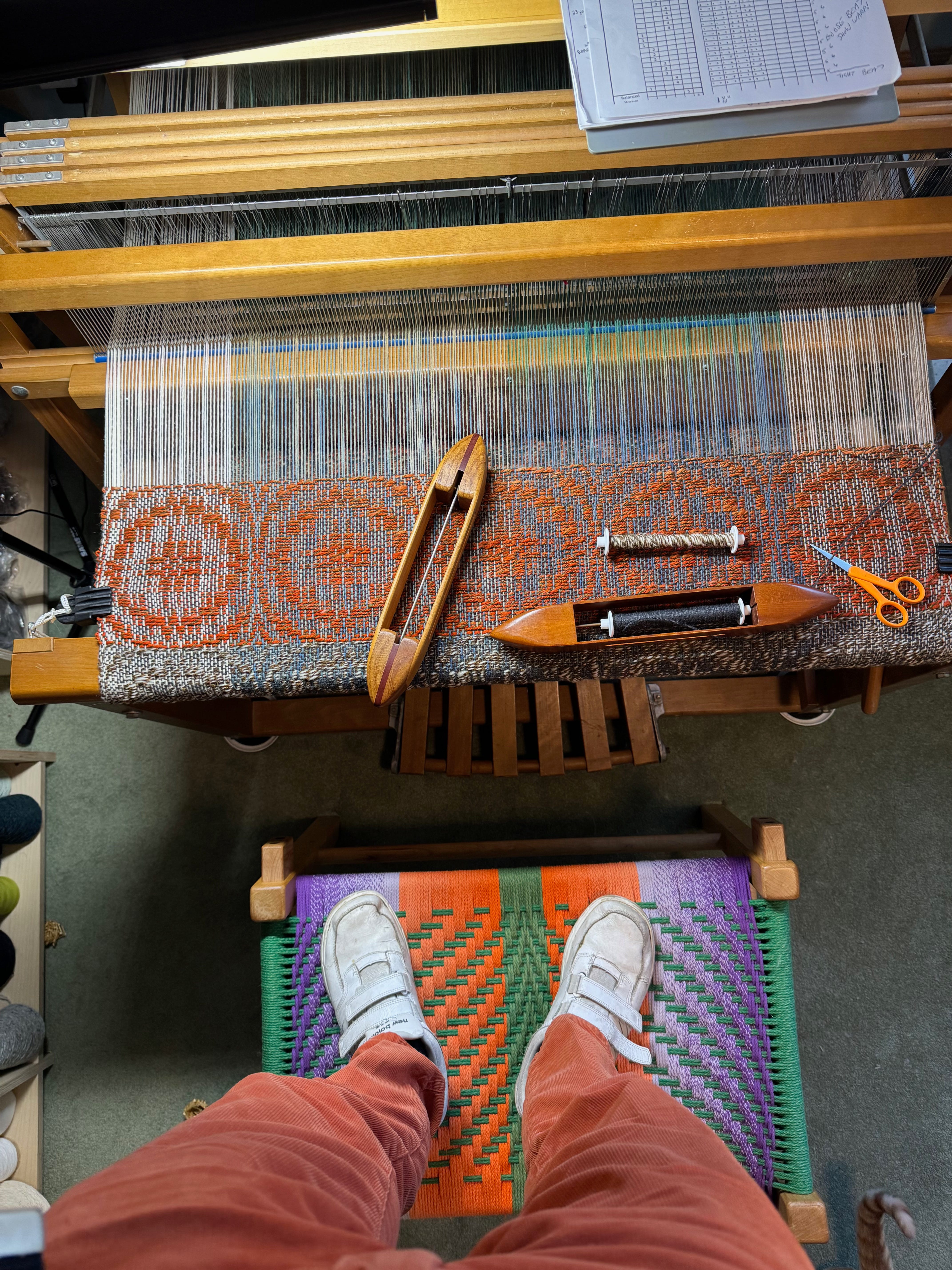
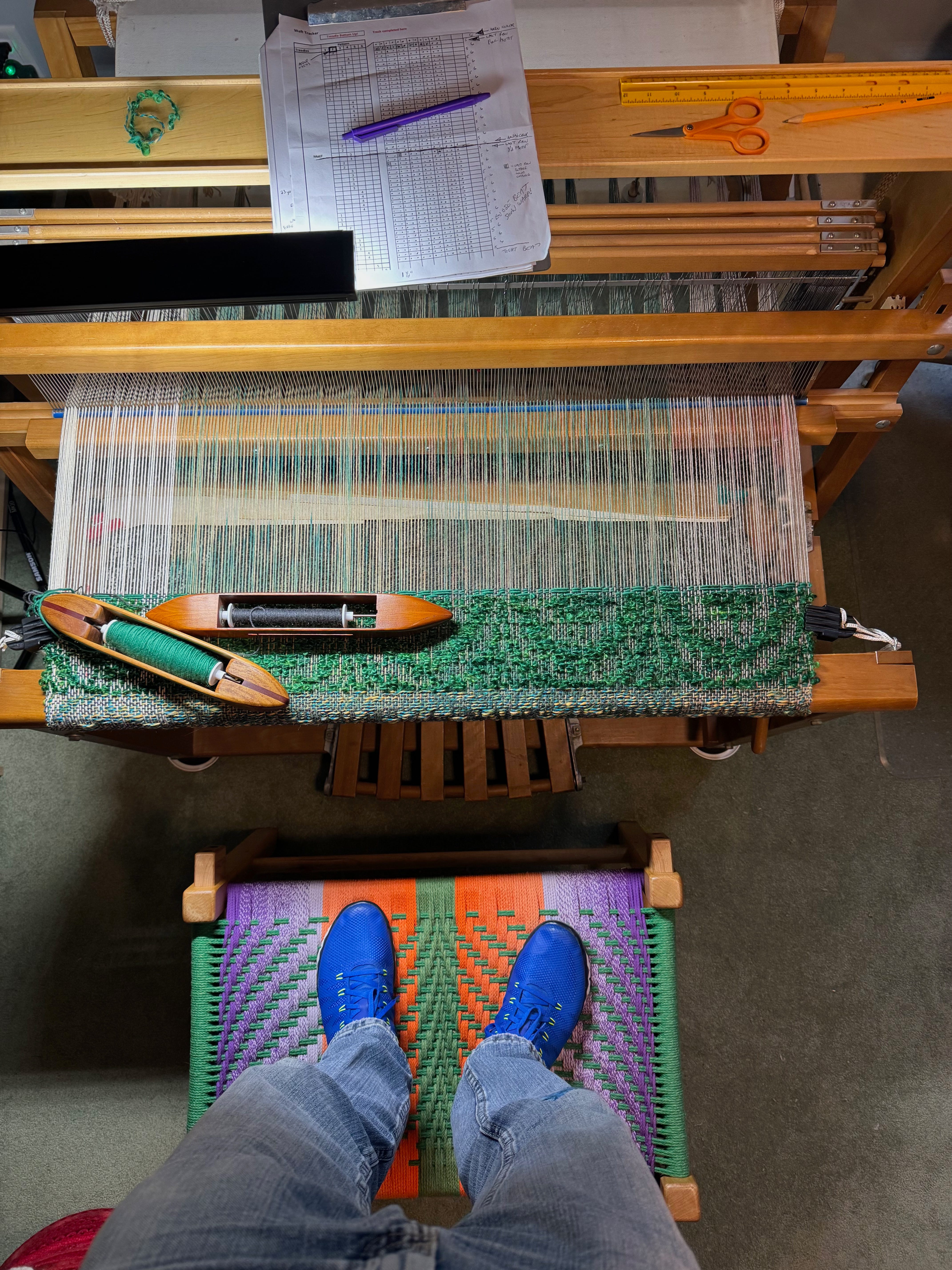
I used newly purchased black linen, and chose similar size threads from my stash in a range of colors in the blue and green hues with an orange and purple (not shown here, because that was a later inspiration). Without those latter two, the project was leaning a little towards boring for these eclectic tastes. The weft fibers ranged widely including wool, mohair, Tencel, and synthetic. My linsey-woolsey desire was partly assuaged.

The loom arrived, early, unexpectedly, but a very pleasant surprise. Putting the loom together was mostly fun. I love those kinds of kits. Starting as a young child with model cars and planes, to miniature furniture as a young adult, to any other kind of put-it-together kit you can image. Love that whole concept.


 The only challenging part of the new Ashford 32” table loom, was hanging the shafts. It was awkward reaching in towards the back for the initial ones. It eventually got easier. But it took me six tries and many hours to finally get it right. The first four times were because I simply misread the directions. Yes, four times! The shafts hang from texsolv cords. This is a type of polyester cord with a continuous series of looped openings which are meant to fit over a small screw head. The challenge however, is that the sixteen heddles need to hang successfully lower from back to front. That combined with the awkward reach was the worst of the not-fun. Everything else came together smoothly.
  

Ashford recommends warping from back-to-front which is new to me. I’ve only ever warped front-to-back on my 4-shaft LeClerc. It required a tweak to the way I used the warping mill to measure out the length of warps. Eight hundred rolls of the mill back and forth later, and I had a warping chain ready for its next step.

The warping steps began on April 20, and took a couple of days. I tend to take lots of breaks and do a variety of things. It is seldom that I have the patience to sit down on one endeavor until the end. I am too anxious for that.

Warping began on May 3rd, and by May 8th the loom was threaded, the reed sleyed, and the warp lashed onto the front bar.

Another first on this project was using my WeaveIt program to keep track of both the heddle threading and the weft treadling. Each motif took 192 ends in the warp, and 192 treadling’s of weft to create each motif. The program was an incredible time saver. The project was a table runner that was two motifs wide which came to about 18” and seven motifs long with a three-inch fringe on each end.

As mentioned, the weft threads came out of my stash. Some were recent purchases in the last couple of years, and others have been in my stash since the days of Franklin Mill and my tailor shop in the mid-eighties! Franklin Mill was a textile mill outlet that sold fabrics and textile supplies. It was directly across the street from my drycleaning/tailoring shop. The mill was this fabulous old stone building with wooden floors. I digress.

Using so many different weft thread types, I didn’t take into consideration, at least not enough, of the elasticity differences, not to mention a very slight wraps per inch difference. So, some of the wide stripes were a tad wider than others. Lessons learned for the future!

Ever since my 4-shaft loom came into my life as a wonderful gift from a friend in the mid-nineties, I have had shaft envy. Like many other weavers before me, I imagined the gargantuan leap of complexity and quantity of styles available to me, if I only, oh, had a loom with more shafts! I checked out many blog posts and comments that attempted to quell or at least keep that envy in perspective. Didn’t listen to a single one. I am extremely happy with my project, the opportunities that more shafts provide, and I love the loom. The rhythm difference between using my hands to raise the shafts and my feet is just different. I don’t mind either way. 

All-in-all, throughout this meander, it was a very satisfying first shaft-envy-fulfilled project! And Samson approves the geometric gem-like motif!


Oh, yes. The magic dye pot, the mohair spinning, are now on the back-burner awaiting their chance to make it to the turn-of-the-wheel creative experiment.


Enjoy!


Alex

Saturday, November 2, 2024

Crocheted Rainbow Hat and Cowl

  Project Dates:  10/13/2024 - 11/2/2024

     This was a fast-food project. Its purpose was to break an old habit that cropped up last year.

     I magnanimously proclaimed the year 2024 to be the year that all old projects would be swept up and finished. My “waiting to be done” bins had numbered to be six. Each bin held on average six projects and they totaled over thirty. An embarrassingly large number.

     In my defense, they have been accumulating through two decades, over six house moves, residing in packed boxes that were sometimes housed for years at a time in storage facilities.

     When I finally put together the current fiber room, the third one in my lifetime thus far, I unpacked a basement full of boxes, and repacked all fiber supplies, and projects, in one location.


            The bins were used to segregate projects in process. The discovery of how many there were resulted from this effort. Yikes!

            It’s embarrassing because one of my early life lessons, that I worked really hard on, and succeeded for a while, was to finish what I started. I loved the flavor of the month in whatever realm we are discussing including fiber art. As soon as I start something, it becomes boring, tedious, and off I was imagining and starting the next new thing. Over and over again. I had it under control for a couple decades, but somehow, it escaped my attention in my fiber hobbies.

            So, I proclaimed the year 2024 to be the year I finish. The plan was to tackle them one-by-one. A year is a long time, right! A game was devised, each project numbered, and a whimsical throw of the die picked the next project. It was a red sweater, knit from the neck down, with the first six inches completed. The fiber is a beautifully soft alpaca in watermelon red. 


            Out of the bin it came. I wrapped it around a mannequin. Dusted off the project notes. Pulled out other red fiber that was going to be used in the sweater. I even proceeded to finish the paper pattern. Then, without my knowing it, I stopped.

            I know, I know. How can I stop and not know it?” How could that be? Well, the boring monster appeared. An email appeared. Quiet. Inauspicious. A fiber farm that I had bought fleece from previously was holding their yearly auction. Fiber at a discount! In the form of a bidding auction. A game!

            Just one look, I told myself. I scanned every sheep, read about their fleece, micron count. My imagination went wild. I could see the fleece arrive, locally sourced! I saw myself spinning it. Making a locally source fibershed qualifying sweater.

            Fibershed is an organization helping to change the planet’s mindset about clothing in a planet and environmentally friendly way, which I wholeheartedly support.

            Well, of course I bid! It came! I had to spin it up! But it takes a lot of time to gently wash fleece. To hand card it. Wait, I had to have the right-hand carders. That took time to find and buy, and arrive! Then learning to card locks, a new experience! Finally got the hang of that.


            Then spun it up in sections. Two spindles of hand carded and wheel spun fiber later, I was bored again. I nearly put that aside several times, but forced myself to finish. Meanwhile, the red bomb sweater, hung on the mannequin, lurking in the room, silent, but loud.

            I ignored it. Staring at my wall of stash fiber, I was consumed by the yellows. They just popped out at me. Like they spoke to me. Everything else paled. It was a divine message! The wall is organized by color. A wonderful statement of art, and supply! But that yellow, and the nearby gold, pulled me in. What you need to know about me is that I have never been a yellow person. This was a NEW experience.

            Hooked! It suddenly came to me. A gorgeous yellow toned woolen cloth to weave and a sweater coat to make! Off on this tangent I went. 


Meanwhile, the red bomb of a mannequin kept staring at me. It loomed large and deadly silent. I ignored it, again. 

            It takes time to plan a weave, select the actual specific correct threads, sample a swatch, measure the warp threads of six colors for the warp, and then four colors for the weft. All in yellows, peach. Then, after measuring the final warp, unfortunately, I didn’t have enough for the weft! So I had to hunt and search, and purchase! How awful!

            The cloth took shape, months of work, and I ended up with gorgeous yellow cloth, meditating in my fiber closet, waiting for a flash of inspiration to become its next incarnation.


            I suddenly looked up and realized that, here I was, ten months into the year, and I had yet to finish the red project, let alone the other thirty projects. That was a sad day!

            After much knawing and complaining, I put the red project away. I put away about six other projects in the fiber room that were started into the “waiting to make” bins. The fiber room felt clean and ready to begin a new life.

            I needed to start again. To really only pick one project, finish it. I hadn’t been listening to my creative self, but to my brat self, who only wanted the next new taste. The only problem with the next new taste, is that over time, it speeds up, and eventually nothing satisfies. Nothing gets done. It is a spiraling addiction like many others.

            I planned a new game. Went through my list to only pick the in-process projects that I actually wanted to finish. Spun the wheel, and this crochet hat project came up.

            It was actually a project Dave started when he was trying to get involved with my passion of fiber art. Not really something he rings to. So, I picked it up, grateful for the smallish project, and finished it up. I made two hats and a cowl.

            I did, unfortunately, have to search for and buy from Etsy, beautiful horn-shaped wooden buttons dyed the perfect shade of light turquoise blue!

            The spell is broke, I hope! On to the next project! And only one, I promise!


Enjoy!

Alex

Friday, January 19, 2024

Abstract Face Punch

 Project Dates:  12/25/2023 - 1/19/2024


This was a short quick project. It was a kit purchased through Etsy from Chloe Art Crafts. This was one of my self-selected holiday presents. I was searching for a kit project. Something easy and new, in the sense of a new-to-me craft. Love finding and trying out new textile tools and techniques. Rather than invest in all the tools for a new hobby, I thought to test it out first with a small kit project.

It’s funny to me how some things just don’t cross your path until they do. I had not heard of punching until almost a decade ago now. A friend was into it and introduced her fascination with it to us. They were doing something a bit different which utilized fabric cut into small narrow strips and then punched into a background fabric. I’ve been curious about it ever since, though only now with just enough motivation and curiosity to actually try it out

The kit I purchased uses a multi-ply yarn. The design is reminiscent of the sixty’s abstract artist Piet Mondrian. The colors and design motif come straight from one of his famous painting. I did another project, a sweater, based on the same Piet Mondrian style. His design was blocks of primary colors with outlines of black lines. Yves St. Laurent also designed a short dress using the same inspiration.


When my sister and I were pre-teens, we received many different kinds of art kits as presents. We tried everything from color pencils to jewelry-making. Mom loved it because it kept us occupied for hours at a time. We tried paint-by-numbers, crafts kits to make tile ashtrays, and there was one even one that reminds me of this punch kit. I don’t recall how it was marketed, but it was a two-dimensional art kit. The background was a painting cardboard with a stamped design. The motif was abstract in the same style as this art piece from Chloe. The outline was done with black cord glued onto the surface. Then there were colored tile chips, like tiny odd shaped grains the size of peppercorns. After the block areas were outlined, glue was dispensed into the bordered areas and the colored chips sprinkled in to fill in with color.

This project went fairly quickly. The result is satisfying. The effort is probably not something I will invest more time with. It just doesn’t provide the same level of satisfaction as some of my other textile hobbies. It was a fun and quick tangent, but I will leave punching as an interesting side trip and occasional attraction, but nothing more. 

Enjoy!

Alex


Monday, January 8, 2024

Pokeberry Stash Blanket

 
Project Dates: August - December 2023

The last several projects I have undertaken have taken a familiar genesis. As I near the end of one project, I get an idea for another one. It becomes persistent. The nearer I am to closing the former, the more persistent and essential, or rather more imperative the next becomes. I am certain there is a psychological connection related to the desperateness of not having another project in the wings. What dire straits I would indeed be within if I find myself without a project in hand. The joke, is that I have several bins of projects waiting to be finished, a list of projects I want to try, but this one that becomes insistent next exists on neither of those avenues. It’s almost as if there is a petulant child that wants to have its turn, as if it never received its turn.

            I have managed to retain some discipline thus far. I did create a project file, and have documented along the way.

            One of the initial motivators was to weave a project that was handspun and dyed. It provides more control, theoretically, anyways. In actual practice, there is still a great deal of directional changes, and spontaneity and happenstance that alters the end result almost unrecognizable from the humble beginnings.

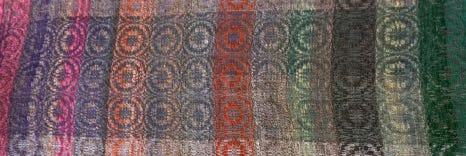
            Another motivator was to create a soft blanket or coverlet with a circular twill pattern, something that has intrigued me for a while.

            Lastly, I was hoping to make this almost exclusively from my stash.

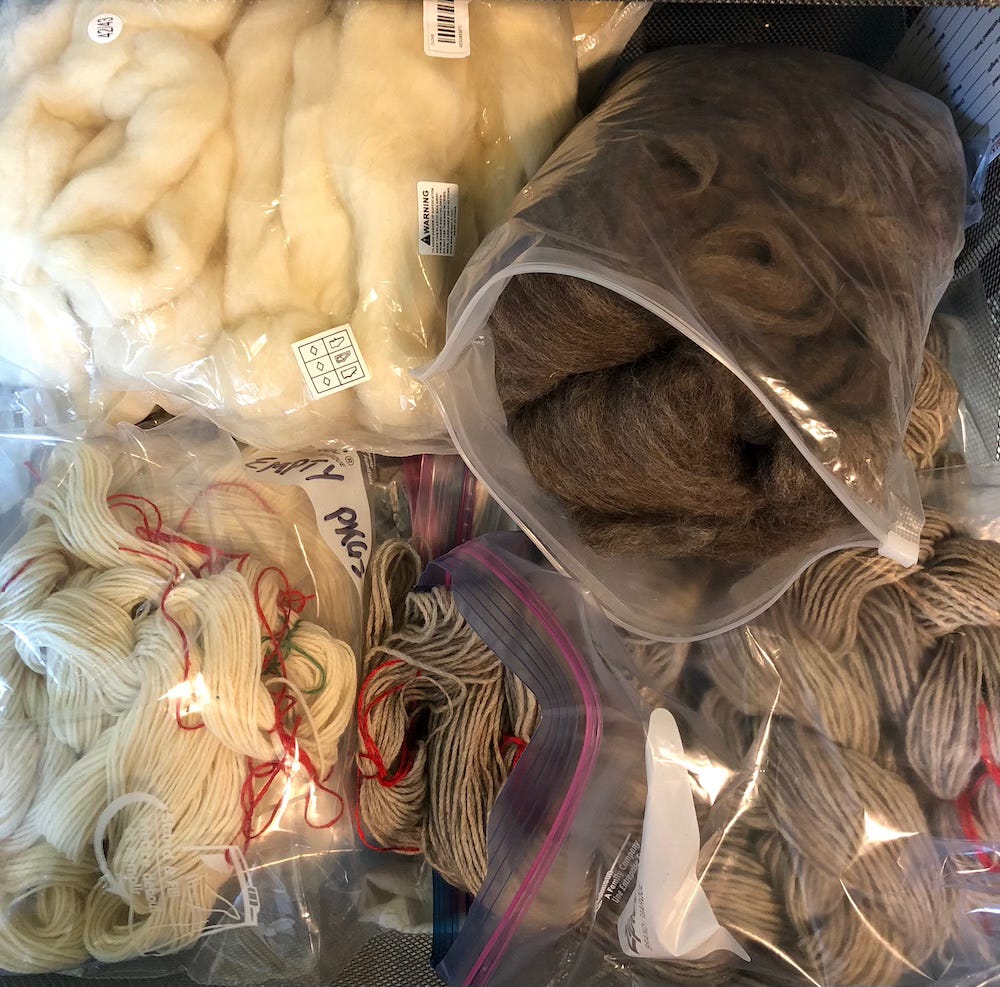
            So, how did this fare? Since the pattern required a taffy weft for every other pattern weft, half the weft was handspun. The other half was inspired by my stash of possum yarn. After doing a sample of the light dove gray in the stash, I realized that a much darker, or even black tabby weft would better contrast the colored handspun. I looked for a match to the possum blend and found the original seller, but thankfully they have replaced the ten percent of nylon in the original in my stash with silk, retaining the possum and merino wool proportions.

            Wool fiber from my stash made up the handspun.

There was a beautiful light brown indeterminate wool roving that came to me in my early learning to spin years a couple of decades ago. The other was purchased more recently over the last decade whilst I was in festival mode, searching and adding to my stash regularly.

            I determined and weighed out how much wool I would need for weft, and also measured and cut my warp thread.

            Both the wool roving and warp threads were dyed using some leftover Dharmaset that had supposedly expired a year ago, but was ultimately still useable. All the stash fiber was hand-painted and dyed using this.

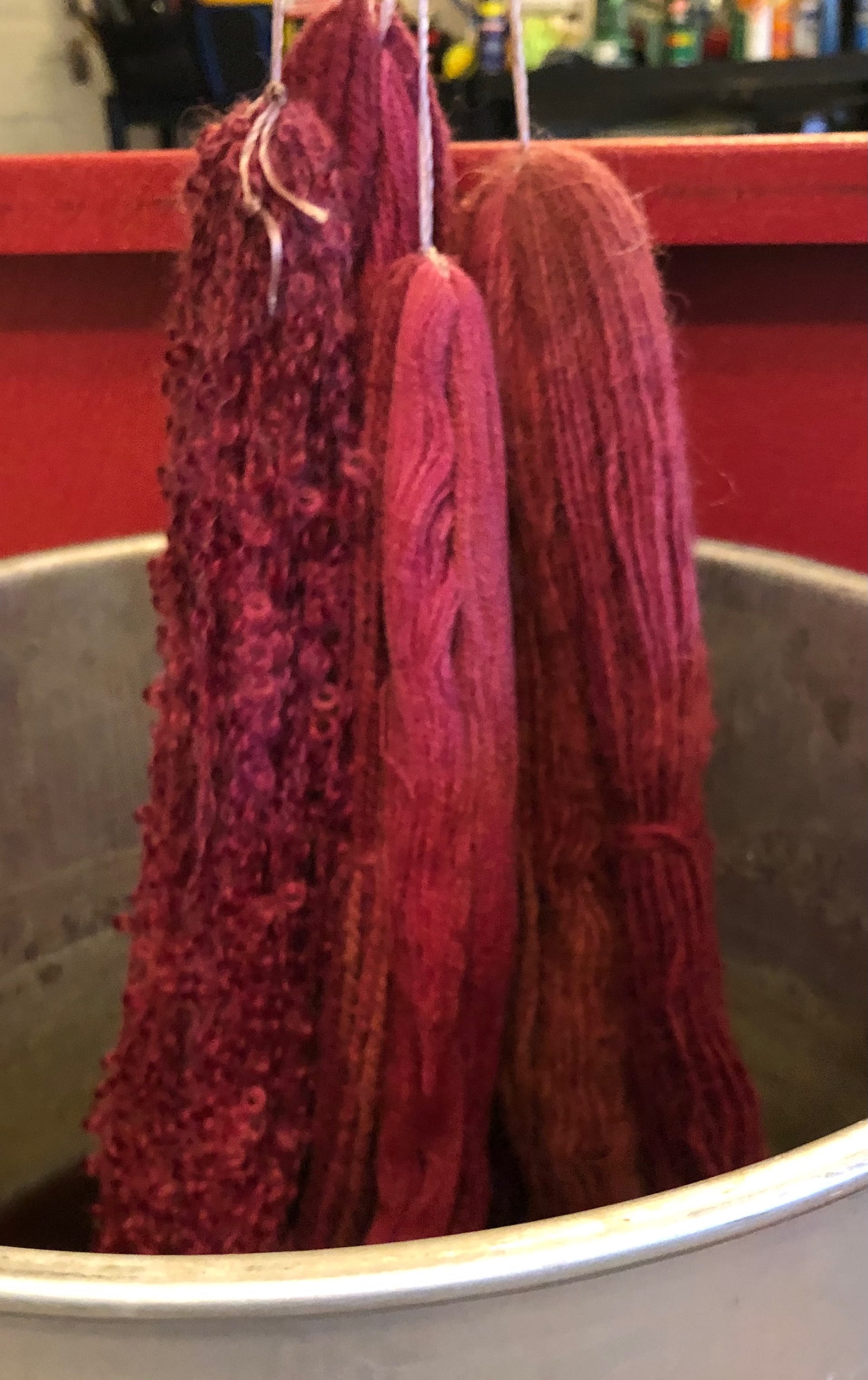
After that was done, I had left a large amount of pokeberry that decided to grow up in many of our flower beds. I collected and used this to overdye some of the warp and weft.

At the beginning of my fiber enthusiast expansion period, a time when I dove headlong into expanding into all aspects of fiber art including weaving, spinning, and dyeing, I had dyed several hanks of different wool threads with mullein and logwood. The logwood turned out a lovely blue purple, but the mullein, beautiful I am sure, was a bit too brown and yellow for my tastes. Three small hanks have lingered in my stash these past couple decades. I opted to throw that into the pokeberry bath.

An interesting accident occurred. I opted to mordant the mullein and logwood dyed fiber first. A lot of the logwood dye entered the mordant water, and I couldn’t believe how much dye came out of the fiber. Unfortunately, I didn’t think about taking a photo beforehand, just after the Pokeberry turned it a beautiful raspberry red. I take it back, I found a photo, just not very good resolution, because it’s buried in a larger photo of the section of stash it was buried within.

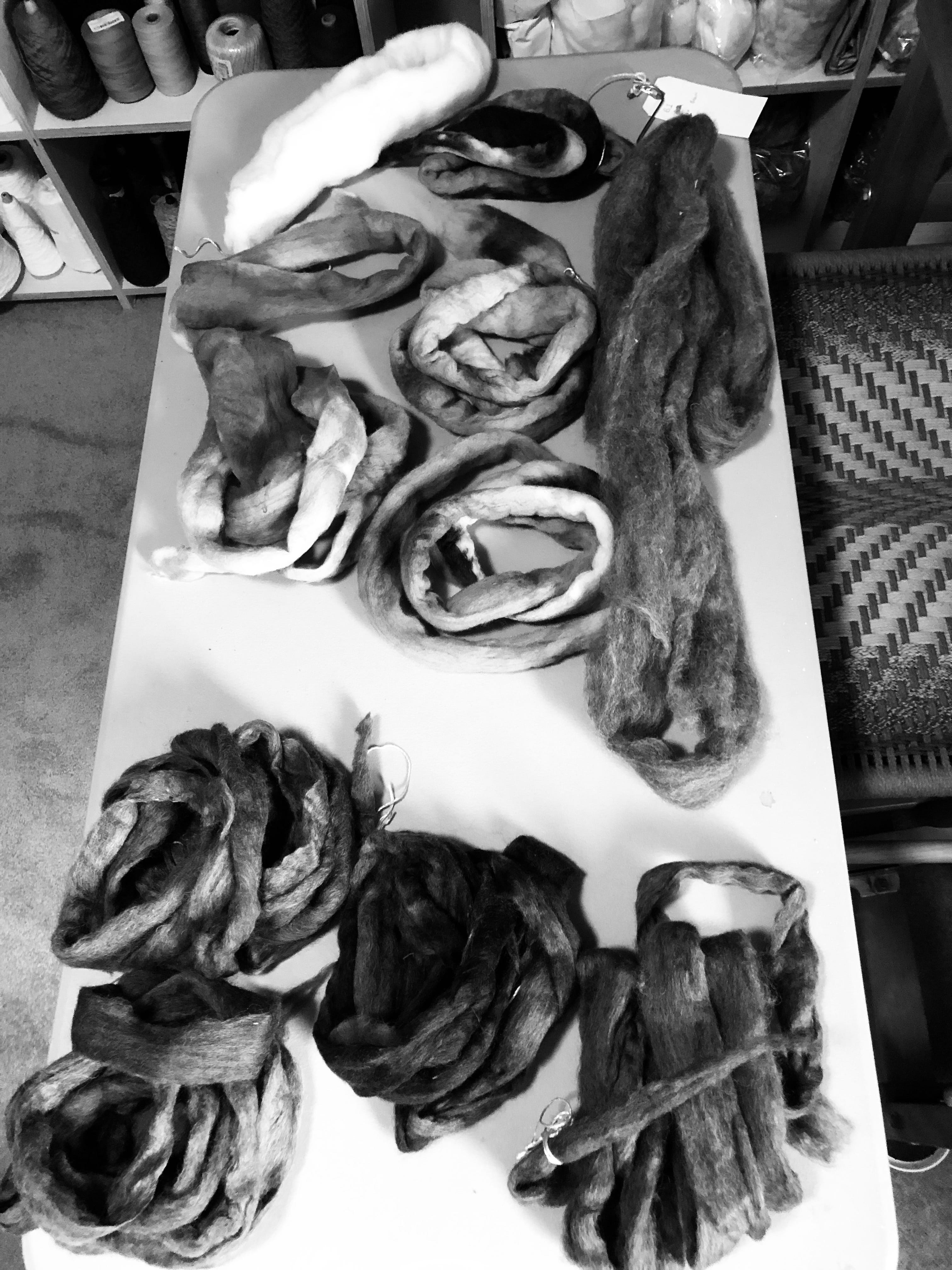
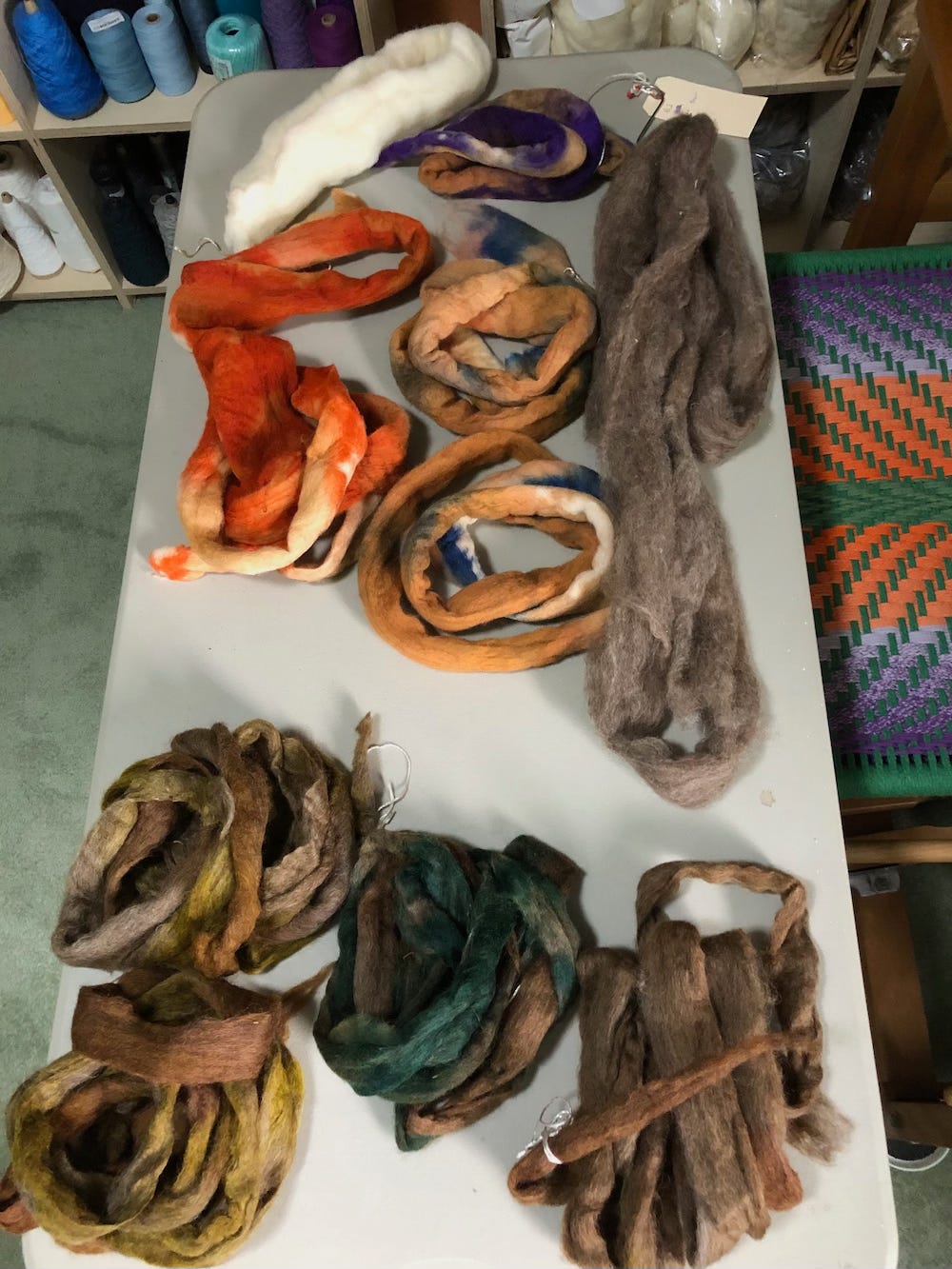
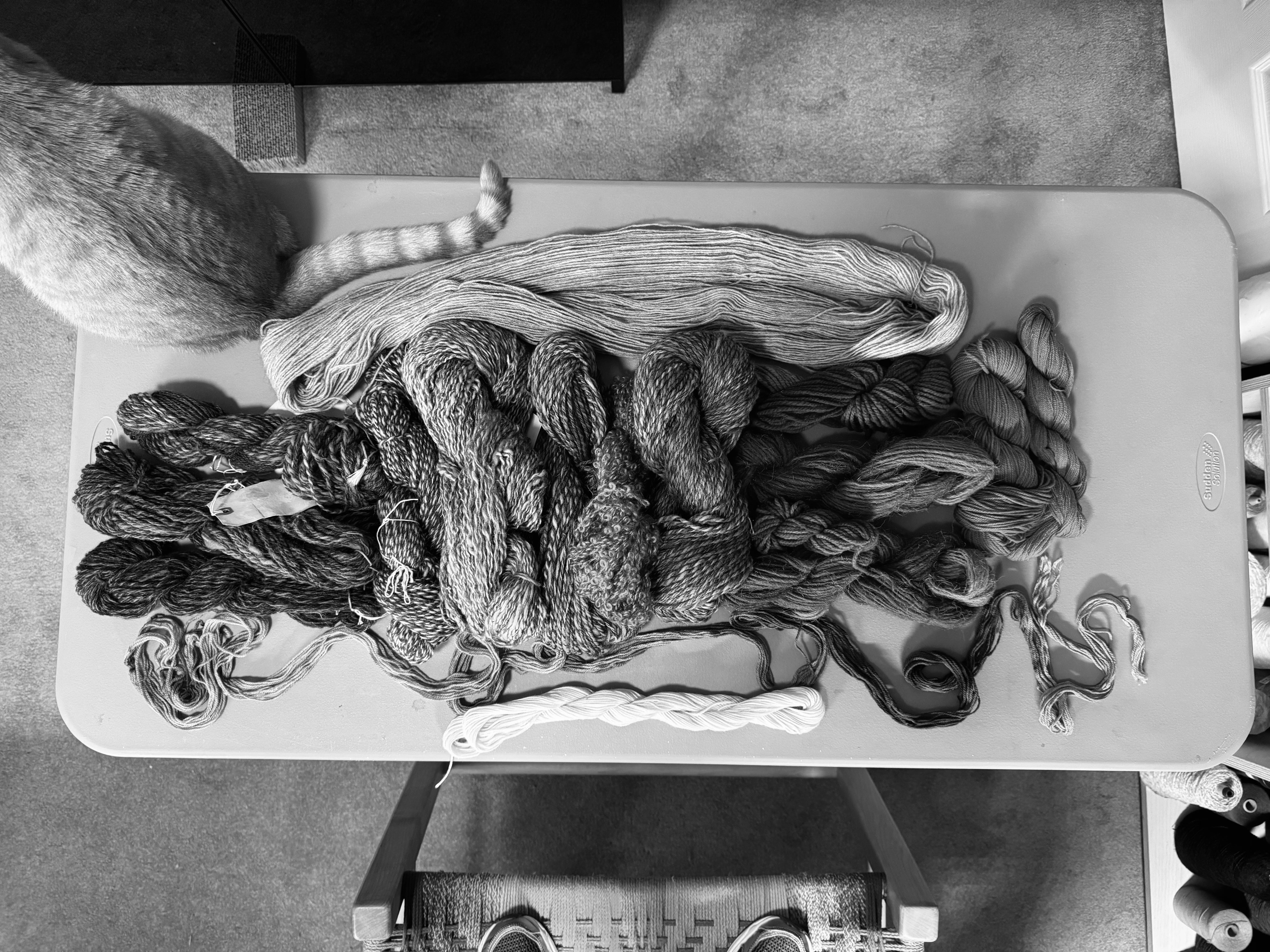
The piles of fiber were studied for contrast using the black and white photo technique. The goal was to have some gradient occurring in the color movement as the colors moved across a muted rainbow. The original design intent was to also have shading from dark to light move across the warp from one side to the other. The roving’s were bundled together into their designated skeins.

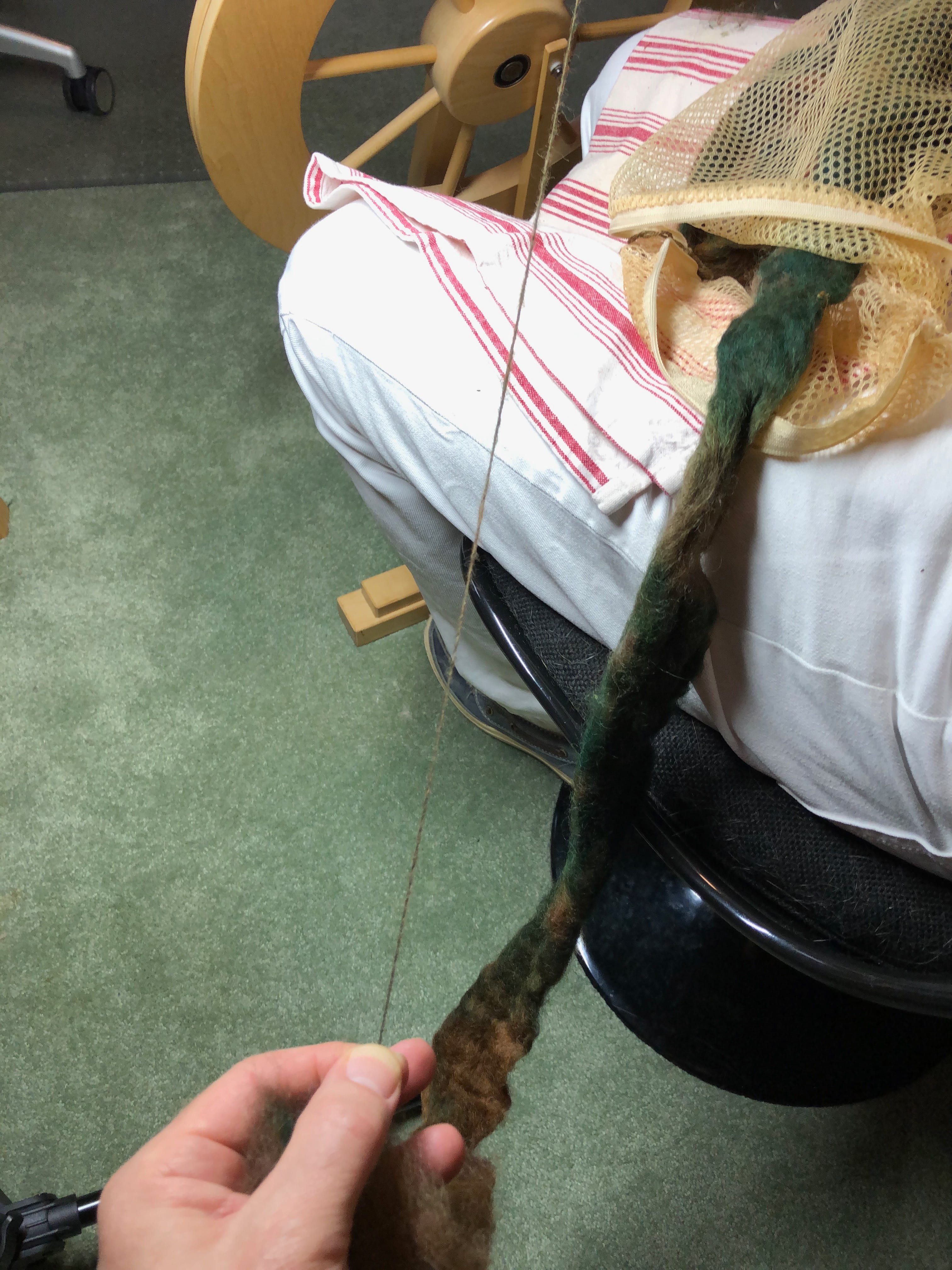
I spun a three-ply worsted choosing to spin each roving bundle at a time. Each single was spun, then the three singles plied. This was very fun and meditative to watch the color variations occur as each single built up on the spindle. Moving the singles through my fingers to ply onto a large bulky sized spindle was like weaving magic. My young feline friends learned for the first time to live alongside a spinning wheel. It was amazing how quickly they learned to leave it alone.

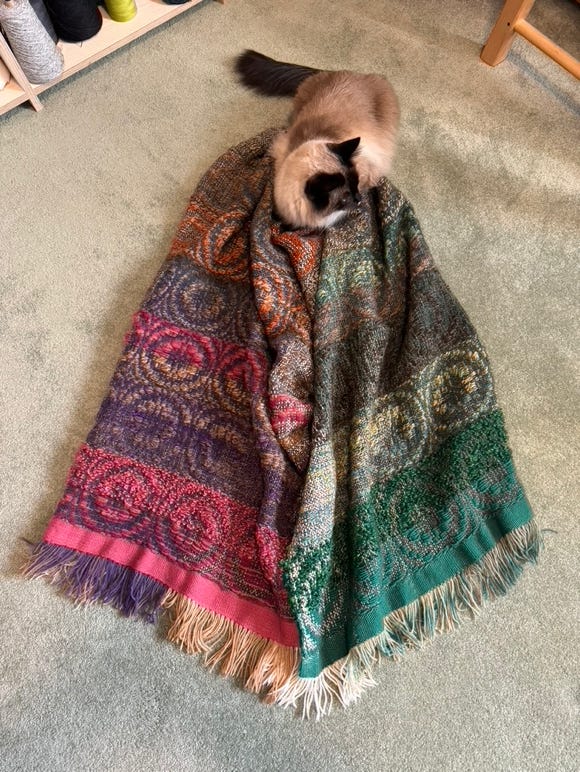
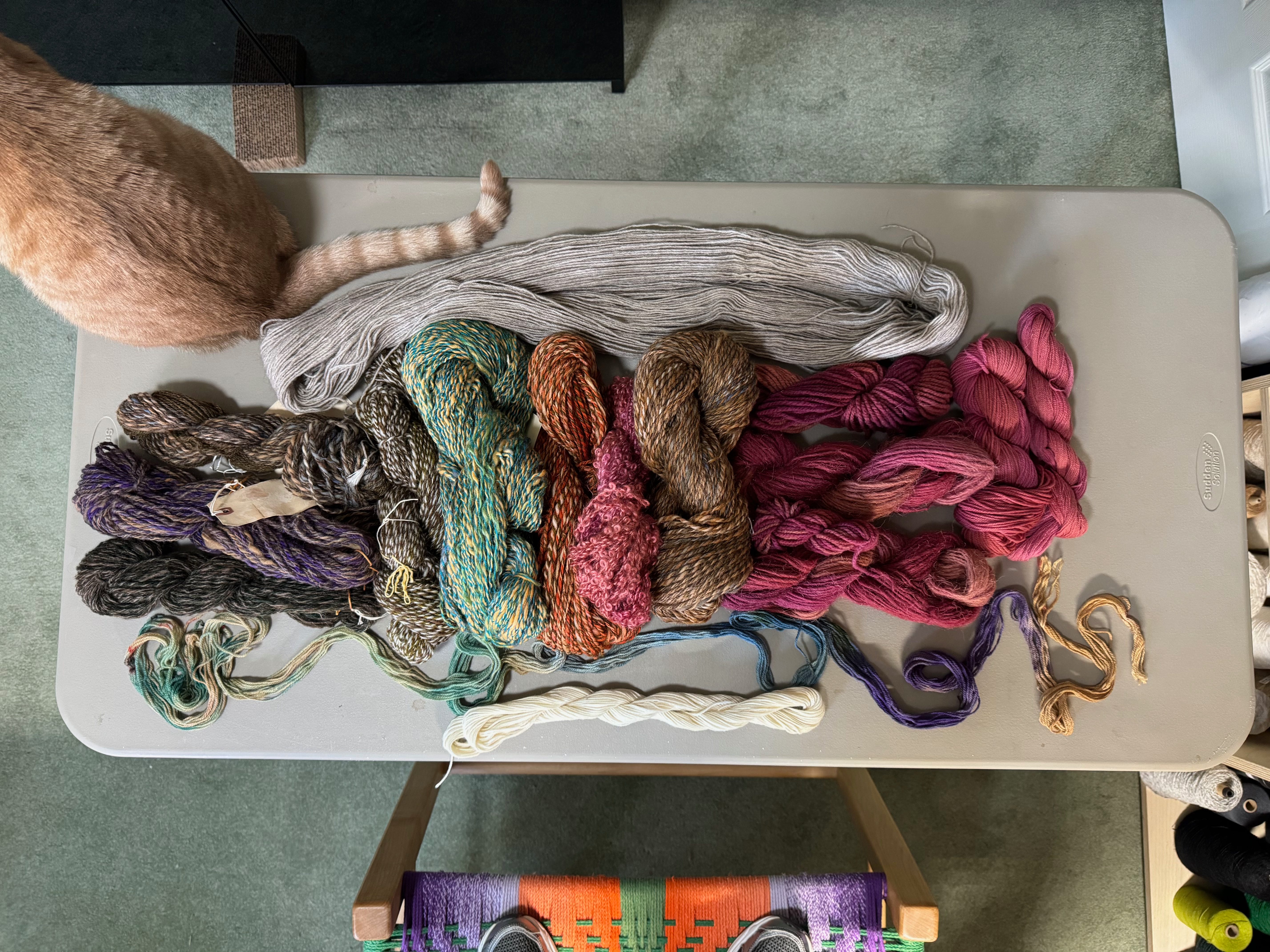
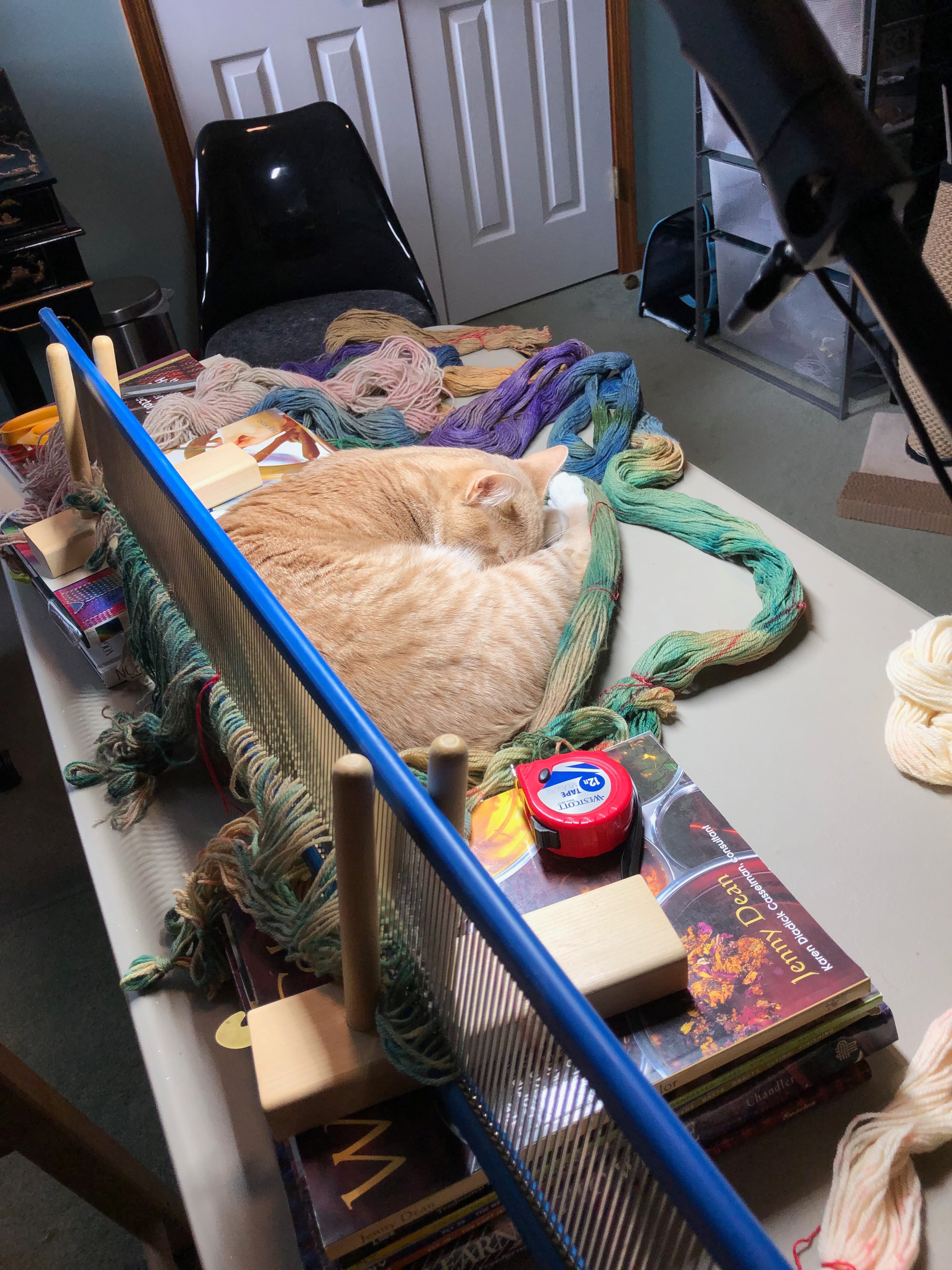
Once all of that was ready, I laid all the fiber warp and weft onto a table to arrange them. The warp was dyed purple to blue to green. the handspun ranged from raspberry to orange, brown, forest green, light greenish blue, to purple. It was a pleasant surprise, even though planned, to have the colors move from one end of the warp to the other aligning pleasantly.  This too was accompanied by my fur friends and while on the table, very surprisingly, let me arrange and sley the reed without any mishap or playful mutterings.

The loom, however, was another matter entirely. Keeping the cats away required constant attention during the weaving process. I get it. There were these tantalizing squiggly wool worms constantly waving in their face. What respecting cat would resist? But that was really only in the beginning. This wasn’t their first rodeo with me at the loom with their company, but it had been a while so they needed to relearn what toys were theirs.

Weaving went fast. It was fun to watch the pattern build up. It was woven very loosely to allow for fulling it later into something wooly, light, and fluffy. In a little over a month, the blanket was woven.

I often dither about fringing and how to edge the product. I usually overcomplicate matters. This time, I opted to leave some of the warp as fringe, no twisting, just a nice simple hemmed stich using same color weft on each end, raspberry at the beginning, and green at the end.

Oh, yes, I should mention that the last two half segments at the end, a beautiful darker green, were especially dyed to coordinate and contrast with the beginning weft which featured a soft and fluffy boucle. Another step in this project had to be added. The end had to be dyed to order! I say this tongue-in-cheek because I love a multi-step project like this.

Fulling was done by agitating gently by hand in lukewarm water until the fiber was locked into place. Then I put it into a dryer at cool temperature checking every few minutes until the blanket was nicely fulled. It finished by air drying on top of that large flat space made by the tops of the front load side-by-side washer and dryer.

The end result was exactly as anticipated. It is luxuriously soft and has that velvet soft feel like wool with a little lanolin. Perfect to take the chill off.